
Choose an agreement family
Open a ready-to-explore published sample, or create a temporary family from your own related documents.
Local-first licence intelligence
AgreementAtlas connects master terms, orders, schedules, DPAs and amendments into one evidence-backed legal map—then answers questions from the exact clauses that control.
The approach
An answer is only as good as the clauses the model gets to read. One agreement fits in a context window; a family of master terms, orders, schedules, amendments and DPAs may not — and as the pile of related documents grows, finding the handful of provisions that actually control a question becomes the real work.
Handing the whole family to a frontier model works for a small stack. The costs arrive as it grows: every document in the prompt is confidential text leaving your control, and a complex enough family will not fit the window at all. Either way the model reads a subset — the question is whether anything chose it.
AgreementAtlas builds that context deliberately: a knowledge graph of every clause, definition, amendment and precedence relationship, assembled before any model runs. Retrieval walks the graph — which definition controls, which order amends what, which document wins a conflict — and hands the model only the provisions that govern, with the exact source text attached.
Context that good changes what the model needs to be. A small open-weight model running locally on a MacBook Pro M5 Pro competes with frontier cloud models on these questions — with confidential agreement text never leaving the machine, and every conclusion tied to the exact source clause.
How the graph is actually built — and what it does not do yet
Inside AgreementAtlas
The workbench keeps the source documents, the evolving legal map and the evidence behind each answer visible together.
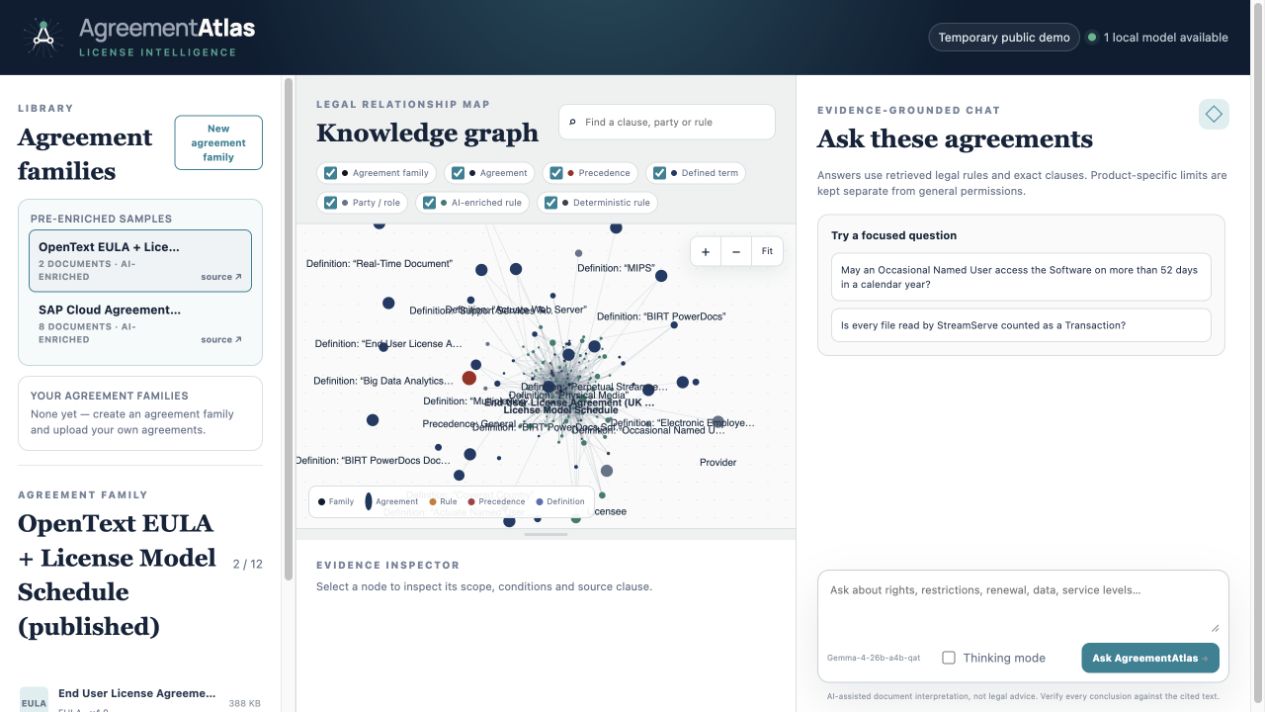
Open a ready-to-explore published sample, or create a temporary family from your own related documents.
See the deterministic first pass immediately. Then choose whether to run the local model for richer clause readings.
Get an evidence-grounded answer with the controlling clauses and the resolution path kept beside the conclusion.
How the experiment is shaped
Clauses, definitions, cross-references and precedence are mapped before a language model is asked to read them.
An open-weight model sharpens individual clause readings on the machine running AgreementAtlas.
A model reading is retained only when its evidence can be validated against the original clause text.
See it work
The samples are already parsed and enriched. If you upload your own documents, they remain isolated to your temporary session. Uploads and generated data are deleted automatically by the time shown in the workbench (a maximum of 6 hours after your session begins).